ONGOING RESEARCH
My research approach follows constructivist, interpretivist feminist theory and methods, primarily focusing on themes of peace and violence, gender and intersectionality, and sustainability. Through qualitative methods and in-depth fieldwork, I engage with feminist ethics of care, feminist phenomenology, and knowledge production debates. For a complete overview of research publications, check out my Google Scholar page.
Gender, conflict, and coercive control

What is the lived experience of women in conflict and political transitions? As a postdoctoral researcher at University College Dublin, I am part of the research project Coercive In/Justice, funded by an European Research Council (ERC) Consolidator Grant. The project develops a new theoretical and feminist phenomenology methodological framework to study the gendered phenomenon of coercive control in contexts of conflict-related violence and transitional justice. I research coercion, peace and violence continuums, and feminist phenomenology, and I also lead a work package on Researcher Wellbeing.
Peace in a changing climate
How does gendered knowledge shape peace in a changing climate? My independent PhD project studies the entangled intersections of climate change, gender, and peace. The way we experience each of these phenomena is embodied and situated: specific to different people, times, and places. Yet, they are not separate issues. I show that care connects climate, gender, and peace as a nexus, and that what we do with that knowledge – in care labor, values, affection, or politics – impacts how we imagine and create peace amidst the ever-growing challenges of climate change. Based on field research with community groups in Puerto Rico, I demonstrate that the tools of knowledge we use direct us toward different peace(s) and different utopian futures thereof. Research on this project is based at the Department of Political Science and Agenda 2030 Graduate School at Lund University.
- Nicoson, Christie. 2021. Towards climate resilient peace: an intersectional and degrowth approach. Sustainability Science.
- Nicoson, Christie. 2024. Imagining peace and enacting utopias in Puerto Rico. Peacebuilding.
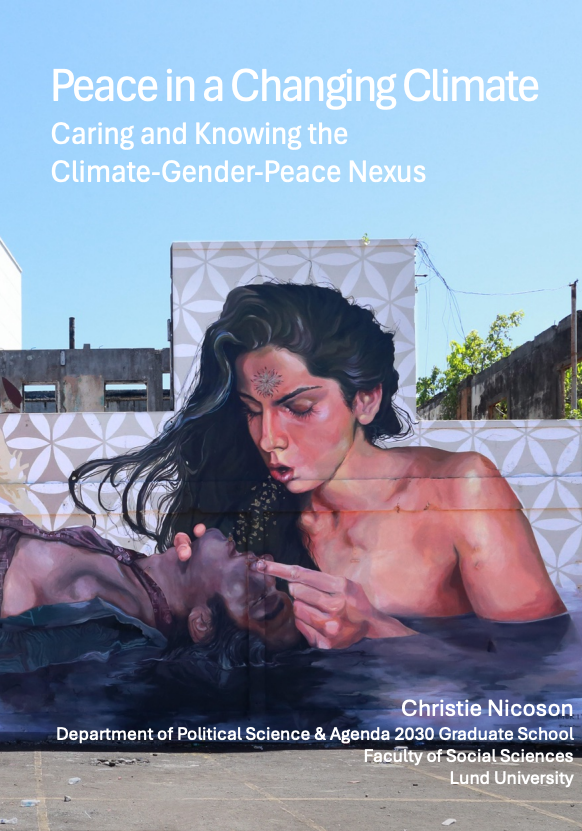
- Nicoson, Christie. 2024. Peace in a Changing Climate: Caring and Knowing the Climate-Gender-Peace Nexus. Doctoral Thesis, Lund University.
- Nicoson, Christie. 2024. Climate Transformation through feminist ethics of care. Environmental Science & Policy.
Environmental peacebuilding
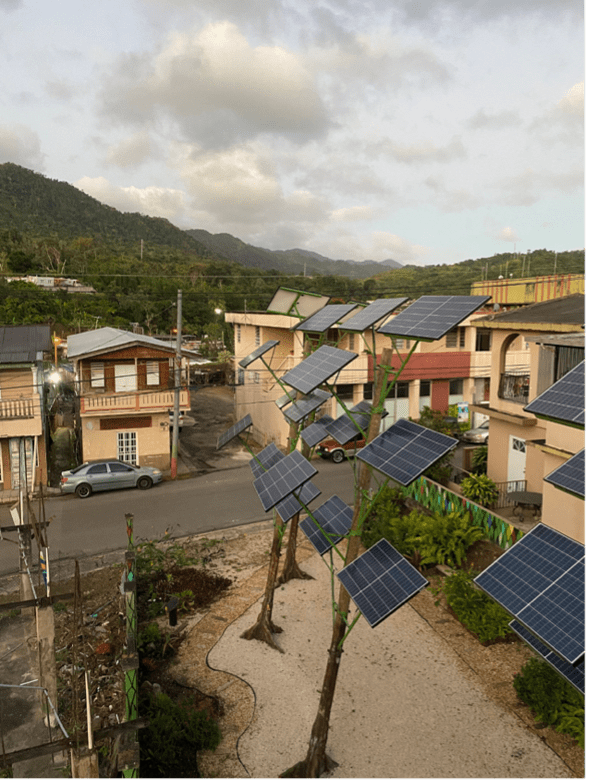
Ongoing research with Barbara Magalhães Teixeira: Based on case study research in Puerto Rico and Brazil, we examine the role of anti-extractivism as environmental peacebuilding through a conflict transformation framework. Environmental peacebuilding aims to foster peace through addressing environmental issues to remedy root causes of conflict; such efforts must further account for and respond to the changing climate. To this end, we explore how community-level movements encounter structural constraints, oppressions, or opportunities. Rather than relying on existing structures as a means to resolve conflict, we suggest that environmental conflict transformation presents an opportunity to foster climate resilient peace responding to differing needs of various groups, extending beyond the absence of war, and responding to the realities of climate change. We argue that the act of negating extractivism is a positive action towards transformation for peace.
- Magalhães Teixeira, Barbara, and Christie Nicoson. 2024. Transforming environmental peacebuilding: addressing extractivism in building climate resilient peace. Ecology and Society.
Environment, care, and food
Ongoing research with Abrania Marrero and Josiemer Mattei: Studying food systems in small island states, we explore different dimensions at the intersection of health, climate change, and colonialism – such as food laborers’ knowledge, biocultural diversity, and socioecological interdependence that shape how communities are able to (re)claim food sovereignty.
- Marrero, Abrania, Christie Nicoson, and Josiemer Mattei. 2023. Food laborers as stewards of island biocultural diversity: Reclaiming local knowledge, food sovereignty, and decolonization. Frontiers in Sustainable Food Systems.
Ongoing research with Markus Holdo: Environmental scholarship needs conceptual tools for critical engagement with current policymaking and practices. In this paper, we explore the critical potential of the idea of “environmental care.” Existing approaches to care within environmental scholarship vary. Some see care as instrumental to a universal ‘good life’. However, for others, an ethics of care applied critically and reflectively politicizes the distribution of care responsibilities and envisions post-humanist kinships of care. Taking Hammond and Hausknost’s call to move beyond the empirical conceptualization of “the environmental state” as a starting point, we ask: what can we demand from the concept of care as a critical tool? Engaging with previous research, we argue that a critical concept of environmental care begins with a situated and holistic recognition of all beings’ interdependence. From here, we engage with questions around (1) reflective learning – building on failure, cycles of life, and decay involved in care relations; (2) temporality – engaging with prefigurations of sustainable ways of life; and (3) interrogating essentialized, gendered assumptions about care relations. When understood this way, critical environmental care visiblizes hitertho invisibilized labor and pluralizes needs, practices, and values; it also holds care advocates accountable to engaging with carefully contextualized places and moments of care.
 Christie Nicoson